Pages

Showing posts with label Bike. Show all posts

Friday, July 6, 2012

my first century ride

Last friday I completed my first century ride – my training plan was to execute an IronMan race rehearsal with 6hrs or 112 miles of riding followed by 1hr or 6 miles of running – whichever comes first for each.

Since there is a fair amount of climbing – I mapped out a course that would be around 100 miles, and have over 9,000 feet of climbing. 

Here’ is the route I took.

1st-century-map

and the elevation profile – both courtesy of Strava – complete detail here

1st-century-elevation

My approach was to ride this as close as I can to an IronMan paced effort.  Based on recent FTP tests,  and targeting 70% of that – my goal was to be around 205-220 watts.  I also broke the ride down into 30 minute segments, this way you closely watch you average/normalized power for a 30 minute window (or box) and don’t worry too much about what has already happened, or what is coming.  This  really helps to stay in the moment and not dwell on how long the ride really is.

I deliberately kept the first segment/30 minutes easy, then stayed steady from there, even during the hilly segments, I tried to keep it within my ranges.  Here’s how it unfolded.

Entire workout:

  Avg Max
Total miles   102.9
Total Time   6:02
Avgerage Power 206 511
Normalized Power 211  
Vi 1.7  
Cadence 85 121
Elevation Gain 8,747  
Speed 17.1 44.7
Temperature 84.6 102.2

With the temperature and humidity, the last 2 hours of the ride was really tough.  As I descended into Sperryville, the temperature went from 85 – 100 within 30 minutes and stayed there for the last 90 minutes.

Overall it was a great ride, it managed/conserved my energy well and executed my fueling well too.  I consumed the following. 

Total calories – 1,900 (316/hr)
                          20oz EFS Liquid Shot + 3 scoops EFS frruit punch in 26oz water
                          6x Hammer enduralytes 
                          approximately 150oz water (filled up twice during the ride)

The other thing to note about this ride was that I went into it with a fair amount of fatigue.  In the 3 days prior to this ride I had done the following:-

  • tuesday – hard swim
  • wednesday – bike FTP test
  • thursday – 2:30 long run – 18 miles

I think with the heat and accumulated fatigue, I managed to have a great long ride, one that sets me up well with 3 more weeks to go before Lake Placid.

Thursday, June 14, 2012

2012 EagleMan 70.3 race report

Final time:  4:55:33 – 44/265 age group place

eagleman2012logo

I ended up with a 21 minute faster time than last year which is a great result.  I did have my share of problems during the race.  In summary I couldn’t hit my power numbers on the bike, I consumed too many combined calories pre-race and during the bike which lead to a nightmare first 7 miles of the run.sunrise

As we arrived at the race site, it was just in time to see an amazing sunrise.  This photo doesn’t really do it justice, but it was a beautiful way to start the day.   As we were approaching the transition area, the race officials announced that the water temperature was below 76.1 so it would be a wetsuit legal swim!  This was good news.  At the same time they also mentioned that compression gear was not legal, not sure that what was all about.  I usually wear compression calf sleeves for the bike/run especially when I can have them on under my wetsuit.

After setting up my transition area I walked around a little and saw the pro’s setting up.  Crowie seemed to be pretty relaxed, even taking the time for photos with some of the athletes.

Swim 33:47 - 1:36/100y

Since there was 8 minutes between swim waves, I had some time to swim for a few minutes to loosen up a bit after entering the water.  I positioned myself about 1/4 across the start line and was able to hold my position easily as I was able to just stand up on the sandy bottom.  As the swim started I settled into a groove and seemed to be making good progress.  I remember my shoulders feeling a little tight, but that ended after the first 5 minutes.  I was not able to draft much, however there were some periods where I managed to get on to some feet for a few minutes.  I had a little trouble sighting the bouys.  I think that was from a combination of the sun angle and them being quite small.  A few times I stopped for a few seconds to make sure I was heading in the right direction.  I remember feeling pretty hot and had some slight cramping in my quads on the last leg to the swim finish.  I didn’t know it then, but this was the start of things getting tough later in the day.  I think a sleeveless wetsuit might have been better.

As I exited the water, I looked at my watch and it was under 34 minutes!  I was really happy with that as my goal was 38 or better.  I swam much better than last year and of course the wetsuit helped.

I still have some work to do swimming a straight line – a few times I found myself  a little off course.  This was better than I had done in the past.  Looking at the gps file from my watch after the race I can see that I was a bit off course heading into the first turn and closing in on the beach.  The Z pattern towards the end is a gps glitch.  The line is amazingly straight since I was wearing the watch (Garmin 910xt) on my wrist.swim-gps-route1

T1 – 2:06t1

As I entered the transition area, I stripped my wetsuit to my waist and jogged to my bike.  I found it hard to run fast through transition – this is something I need to work on.  I think I’ll add some swim to run bricks to get better at this.

Bike – 2:28:38 – 22.6mph

I started the bike conservatively.  My goal was to start a little easy to lower my heart rate and then build into the ride working up to my target watts range of 240-255.  I found it hard to hit my target or even come close. I think a combination of the heat and some lingering fatigue meant I was unable to ride at the watts I intended, and my HR was higher than normal.  I ended up with a normalized power of 226 (average 221) for an IF of 1.02 and an average HR of 161.  This is very different to some recent training rides where I was able to hold the same power for 5 hours at a lower HR.
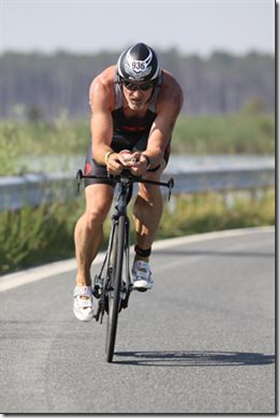
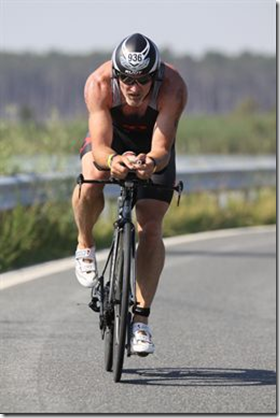
bike1 bike2

Even though my power numbers were lower than I wanted, my perceived effort felt about right.  I had set my bike computer to show only power (3s avg, lap NP, Lap avg), cadence and HR. Each 5 miles or so I would check my speed average which sat at 23mph for most of the course.  I was really hoping that riding at a fairly easy effort would mean my legs would be fresh for a good run.

In the first 20 miles of the bike I saw the race referees on the back of the motorbike many times.  At one point I was behind a small pack of riders when I saw the referee point to one of the them and give him a penalty card.  When that happens you have to stop at the next penalty tent.   Over the course of the race I saw them hand out a number of time penalty’s . 

My nutrition plan for the bike was to take in calories every 12 minutes.  I have used this strategy for many races and it has worked well.  My sole calorie source is EFS Liquid shot (vanilla).  I fill up a bottle that sits between my arms and add some water to make it flow a little better.  I set my garmin bike computer to beep every 12 minutes and drank the EFS liquid shot every time, except the last one before getting to T2 since I only had a mile of so to transition.

At the final aid station, somewhere around mile 45, I stood up a little to stretch out.  Wow, my quads felt really tight and sore.  I didn’t really feel any discomfort when riding, but it was clear that I may have some trouble on the run.

What I realize now is that I had taken in too many calories when I combined pre-race and on-bike consumption.  I was aiming for a maximum of 400 calories per hour on the bike.  After analyzing what I had eaten after the race I calculated that I took in 1,450 calories before the race started and another 930 calories on the bike.  My HR was higher than usual  (low 160’s compared to mid 150’s) combining that with the heat and I think I had more calories than my body could process.  All of this lead to some real problems on the run.

T2 – 2:29t2
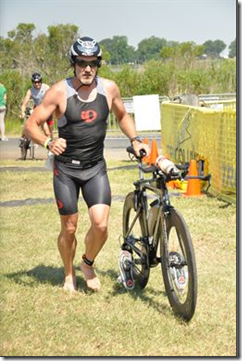
I executed a decent flying dismount entering T2.  I always leave my shoes on the pedals as I don’t really want to run in them.

This year I took a few extra seconds to put socks on.  Last year I completed the run without socks and with all of the water I used to cool down, my feet were wet and I got some nasty blisters.  It did feel better to run in socks, I think for Sprint and Olympic races socks aren’t needed, however for 70.3 or higher I’ll wear them every time.

I didn’t waste any time, put socks & shoes on – grab my had an fuelbelt and proceeded to the run exit.


Run – 1:48:35 – 8:18/mile pace

The run was my nemesis last year at this race.  I faded badly over the last 3-4 miles due to the combination of heat and lack of nutrition.  This year I was hoping for something better.  It wasn’t to be. 

I started out running steady, trying to get my legs back into running mode.  I remember it feeling very slow.  As I passed the finish line, I saw Greg Bennett cross the line in 2nd place in the pro race.  That kept my mind off things for a little while.  My first mile I was feeling a little off, but it turned out to be an 8:05 pace – this was much faster than it felt.  During mile 2 the wheels seemed to fall off a little.  Not far after the first mile marker was the first aid station.  I grabbed some water and ice and I could feel my quads feeling very tight.  After walking the aid station I started running again.  I got through the 2nd mile in 8:33 – still decent, but was feeling very heavy.  I just couldn’t get moving.  At one point I stopped to stretch my right quad, and as I lifted my foot up, my hamstring started cramping.  Oh dear.  Not a good feeling.  run

I remember when this picture was taken.  It was around the time where I felt the worst.  You can see some of the pain in my facial expression, but I was feeling much worse than it looks.

After my attempt at stretching was a total fail, I figured I should try to run again.  I did not want to get in to the pattern of waking when things got tough.  I held on to the thought that things would turn around, just stay patient.

Mile 3 was 8:20 – considering how I felt, the time was actually pretty fast.  During mile 4 I was feeling awful. At times I thought I might throw up.  I had a very heavy feeling in my stomach.  I was hoping to be feeling better by now but almost 4 miles in things were not feeling good at all.   I made a quick stop at a port-a-john and felt a little better.  Including the stop, mile 4 was 10:03.  At that point I was really in a survival mode, not really caring about what time I was running.

Miles 5 and 6 I was still feeling it but somehow managed to complete miles in 8:14 and 8:36.  This included walking through the aid stations. Mile 7 included the turn-around and we hit the same aid station twice.   At each aid station I took off my hat, filled it with ice and put it back on again.  In addition to that I had 1 or 2 cups of water.  I glanced at my watch at the turn-around point and it had taken me nearly an hour to get there.  That was much slower than I was hoping for.  I started doing some numbers and I would need to average 8 minute miles to break the 5 hour mark.  I didn’t really think I could do it.  I just kept telling myself to hang in there and things would turn around.  Mile 7 was 9:27.  Around this time I saw Carly – she was only a mile behind me and was looking strong.  Her start wave was 16 minutes behind me too – so I knew she was having a great race.  The way I had been running, I thought she might pass me before the finish line.

As I started mile 8 I did start to feel better.  I remember feeling lighter and felt like I could pick the pace up a little.  Mile 8 was 8:02, mile 9 8:13 and mile 10 was a 7:52.  I walked all of the aid stations.   At mile 7 I put some ice down my shorts – that felt really good and may have been the catalyst to get me going again.

At this point I had 3 miles left and my patience was starting to pay off.  I was feeling good enough to pick up the pace a little more and started passing people too.  Miles 11, 12 and 13 were 7:50, 7:35 and 7:03.  during the last few miles I felt like my form was good.  I still had a chance at a sub 5:00 time.  As I got close to the finish I was able to give it a little more, finishing hard with at time of 4:55:33.

This was the tale of 2 different runs.  The first 7 miles felt like a death march.  But things did turn around for the final 6 miles.  My splits for each half of the run (6.6 mile) segments were 57:17 & 51:17.  That is a nice negative split.

After I had finished I felt remarkably good.  I sat down in the shade for a few minutes – there was a row of chairs provided right at the finish line which was great.  I waited for Carly to come across the finish line.  She had an amazing race, finishing 4th in her age group with a 4:52:18!

Post Race Analysis

I think there were a number of contributing factors to my performance

  • I have been building up my long run/rides for IMLP.  Since this was not an ‘A’ race, I didn’t really taper or specifically prepare for this race.  In the 7-10 days before the race I completed a 2:10 run and a 5:00 ride a week before this race.  During the weekdays before the race I had a really busy work schedule and missed some workouts.  I think I was still fatigued from those long efforts on race day. 
  • my work/travel schedule for the last 6 weeks has been crazy, I was traveling 5 out of the pervious 6 weeks.  this makes consistent training hard, and makes me tired.
  • Total calories combined pre-race and during the bike was around 2,400.  I think that was way too much for my body to handle.  The fact that my running came around in the last 3 miles proves this.  I will have to be more diligent about total calorie intake next year.
  • the wetsuit swim in warm water may have contributed to starting the bike a little overheated

Apart from the nutrition/fatigue challenge I had a really good race. You can never be disappointed with a 20 minute PR.   I really think had I been at full power on the bike and not had the nutrition issues, I could have taken 8-10 minutes off my finish time.

After a few days rest, it is time to start the last 4-5 week build leading up to Lake Placid.  II am looking forward to the race, and equally looking forward to dialing things back after the race.  Preparing for long distance triathlons takes a lot of effort.  I am finding it hard to make the time to train more than 12 hours each week.

Monday, September 5, 2011

Using Strava to analyze your rides

An alternate title for this post could be simply “Strava is awesome”.  I recently was put on to strava via a friend.  Originally I had thought it was just another online tool to track bike rides & runs like Garmin Connect or trainingpeaks, both of which I use frequently. 

But then I had a look at strava, and there are a couple of features that really stood out:-

  • comparing sections of a ride with others – with King of the Mountain competitions
  • identifying the climb difficulty and statistics – e.g. category 2,3,4, % grade, elevation gain etc.

So I signed up for a the free service and immediately I really liked what I saw.  I have been riding a bit recently in the hills out at Skyline drive, the first of any sort of mountain riding I had done.  When I uploaded my first ride, I could immediately see how difficult the climbs were, and it told me what position I had finished against anyone else who has uploaded a ride from the same location.

Here’s an example:-first-ride-elevation
not only can you see the elevation for the whole ride, it split up the ride into segments automatically. In addition to that, you see a table with your performance for each segment.  You can also add your own segments.
.first-ride-table
I found this fascinating.  The first climb of the day was a tough one, after a 4.5 mile descent the climb is 3.9 miles, it is rated at a category 2 (same scale used in the tour de France).  It took me 26:37 to complete the climb at an average pace of 8.8mph, with an average HR of 152.  It also estimates the average power for the climb, for those like me without a power meter.  When you click on the climb segment, you get even more detail – like the grade being an average of 5.7%, and information about who is the fastest man & woman to complete the same climb.  Once you have loaded up several rides along the same segments, you can compare your own best performances too.

If you look closely at the icons on the left column of the chart above, there are some awards there too, it will tell you if you have a new PR or even if you made the “KOM” King of the Mountain. 

Of course you can choose whether to keep your information private, or public and compare to others.   There is an element of social networking built in too – friends can leave comments on your efforts and can click on the “Kudos” button (just like a “like” in Facebook).

It is possible to create your own segments too – they don’t have to be just hills.  Last weekend I combined 2 rides that I often do into a single long ride.  I created segments for a tough out/back and another segment for a loop I often do, so now whenever I go back, I have something to compare them too.  When you create a segment, you can choose to keep it private, or make it public for everyone else to have a go at.

Here’s another example:

An out and back section of almost 17 miles with a decent amount of rolling hills.carters-run-elevation

and after uploading 3 rides where I completed this section, I can compare the results.carters-run-comparison

Part of the reason for the difference in speed/time between May 22nd and June 5th was switching to racing tires.  The ride on August 20th was part of a 3hr ride, not sure why the HR was up as high as it was, but it is good to see that I was only 25 seconds slower than the last time where I felt like I went harder on a much shorter ride.

I’ll often catch myself thinking that I had a “great ride” today – now I have a tool to help me understand this much better.  It won’t just be a perception any more, or an overall average speed that I use, with Strava I can analyze it in many different ways.

You don’t even have to have a fancy bike computer.  Strava supports Garmin devices, and there is also an app that you can download for the iPhone and Android platforms.

I think it is my new favorite tool!

Wednesday, August 17, 2011

Weight Loss Update–2 days in, 4.8 lb. down

I am now 2 days into my effort to drop a few pounds before my next race in just over 3 weeks.

So far it is going pretty well, here’s an update of my progress.

  • Day 1
    • Start weight: 185
    • 1hr run in the morning, 3x1 mile repeats, afternoon 30 minute swim
  • Day 2
    • Weight: 182.5 – down 2.5
    • feeling a little tired.  Masters swim in the evening.  In addition to the egg whites & avocado, I had a muffin and Hammer bar to fuel the masters session.  Felt good.
    • Skipped my planned run workout today, have some pain in my left heel.  It is probably Plantar Fasciitis, so I need to rest my feet for a few days.
  • Day 3
    • Weight:  180.2 – down 2.3 since yesterday, 4.8 total
    • bike interval session this morning, planned 4x10mins @ 255w with 2 minutes rest.  Got through the first 2 intervals ok, but struggled on the 3rd, stopped 5 minutes into the 3rd work interval, and rode 15 minutes easy, with a 3 minute hardish effort.  Usually I’d consider that a fail, but I think the lack of fueling before the workout hurt me here.  Ran a 20 minute brick after the ride at a pretty slow pace and felt ok

So far I am pretty happy with progress so far, let’s see if I can get under 180 tomorrow.

Tuesday, June 7, 2011

Bike Progress

Last weekend I chose to do a 34 mile hard ride, followed by a 30 minute brick run.  Since it was 1 week out from race day (EagleMan) I wanted to complete one last race style test before starting to taper for the race.

I made a few changes to the bike in preparation for the race:-

  • added a water bottle holder for between the aero-bars, for carrying nutrition (most likely EFS liquid shot)
  • fitted 2 new tires with latex tubes
    I purchased 2 Specialized S-Works Turbo 700/23c competition tires, and ordered some Michelin A1 AirComp latex tubes – 700x18c-20c.  These tires have 220tpi casings and are a much lower rolling resistance than the standard Bontrager R1Plus that came with my bike

The course that I chose was a challenging out/back with a lot of hills, for the 33.3 miles there is a total of 2,400 feet of climbing, see the elevation profile below.
carters-run-elevation-profile

I have completed this ride twice now – here’s the statistics for each.

Date

Total Time

Avg Speed

Avg HR

Max HR

Max Speed

22-May 1:45:09 20.1mph 141 160 36.8
5-Jun 1:39:39 18.9mph 140 158 38.3

This is a huge difference/improvement.  Only 2 weeks apart and a 5:30 faster time and a 1.2 mph increase in average speed.  The lower rolling resistance of the new tires/tubes seem to have made a large difference.  My fitness is probably better too, but that should only account for a 1-2 minute advantage.  I am really happy with this result, especially with EagleMan within a week now.

If I look back to just 1 year ago, I was about to head into my 2nd knee surgery of the year, and had not been on my bike since October of the year before.  Before then I struggled to average 18mph for any ride, even flat courses.  To have come so far in a short time is really amazing, and something I need to remember if I ever get down about a performance.

I am still aiming for a minimum 20mph bike leg at EagleMan – it is likely that I will go faster, but this is my first long-course race and I want to be able to run strong.

Friday, April 29, 2011

My New Bike–a first look

Today was a great day.  I ran for the first time in almost 2 weeks, 30 minutes at better than 8 minutes per mile, that felt really great, no pain at all. 

What felt even better was going to pick up my new Triathlon bike – a Trek Speed Concept 7.0.

IMG_1662

the quality of the photo is not great – because it is dark and I used my phone.  I’ll take some better pictures this weekend.  I can’t wait to take it out for a spin on Sunday.

I went into the fitting process liking both the Trek, and a Felt B14/B16.  After a couple of hours of fitting and testing both the Trek and Felt, I decided to go ahead with the Trek.  I really liked the look, black was my preferred color.  I also liked the feel of the brakes and the gear changing mechanism on the Trek better too.  The other advantage are all of the integrated components, like the draft box for spare tubes/tools etc. and the duotrap speed/cadence sensor that when installed fits flush with the frame.

I haven’t finished yet, still have to install the speedfil for hydration – but so far not a single zip tie!  I am also wondering if the shop installed the top tube box backwards.  A quick look at the trek website seems to indicate that it is. 

I spent a total of 3.5 hrs at the bike shop making my selection and getting fitted.  It feels great, but the fitting process is still not complete.  I will ride it as is for the next few weeks, and get used to the aero position.  After that we’ll probably steepen the seat angle and lower the front to get into the best position possible.  At that time the new pedals should be in too (speedplay X/2). 

Monday, April 4, 2011

MTB Ride in California

I often travel to my company’s headquarters in Redwood City, California.  Last week I managed to get in an afternoon mountain bike ride in Belmont, out of the Passion Trails Bikes shop.  they set me up with a sweet full suspension 29er (Pivot 429) and off I went with a friend from the office.  The people there are really great, and they had a bbq after their usual Wednesday evening ride along with a few beers, what more could you want!

We managed to squeeze in a 2.5 hr ride before the darkness set in.

I haven’t ridden an MTB for many years – it has got to be about 10.  The training over the winter in the basement seems to have paid off as I was easily able to keep up and power through the whole ride.  I thought my bike handling would be a but rusty, but after the first few descents I was ready to go.  The terrain there was really varied, a lot of narrow single track and many steep & technical sections.  There are a lot of trails that intersect and the view from the top of some was magnificent.

Here’s a few that I managed to snap off – they aren’t the best, I was focusing on riding and not playing tourist!

IMG_1651

It was such a beautiful day, in the mid 70’s.

IMG_1654

from near the top – you can see the bay close to Foster City.

IMG_1652

this one is looking more towards redwood city – we rode the trails all over the valley in the foreground. 

this last picture is not one of mine – I grabbed it from the Passion Trail website.  I remember riding this section both up and down.  it is actually steeper than it looks.

belmont-mtb-sample

I am really looking to getting back there again for my next trip – which is looking like it will be the end of April.

Tuesday, November 30, 2010

Why I love my Computrainer

Today I completed another interval workout.  It was a tough workout, but that is what intervals are all about.  I did it on my computrainer – using the coaching software.  This allows me to specify the precise power that I need to generate for the whole session. 
Today’s session looked like this:-

  • Warm-up – 10 minutes
    • start slow and increase power for 7 minutes
    • hold 172 watts for 2 minutes
    • rest for 1 minute
  • Initial Set – 5 minutes - to get ready for the main course
    • 30 seconds @ 230 watts
    • 30 seconds @ 123 watts
    • repeat 5 times
  • Main Set – 45 minutes
    • 6 minutes @ 240 watts
    • 3 minutes @ 123 – recovery between sets
    • repeat 5 times
  • Cool down – 10 minutes
    • reducing watts to around 125

1hr 10mins total – the actual watts were calculated based on power from previous workouts.  The great thing about this is that it really helps to keep your focus when all you have to do is ride, the computrainer dishes out the power/pain – so there really is no cheating.  I’d find it hard to do this workout on the road or a regular trainer.  Most of the time I listen to music or podcasts whilst riding in the basement.

The cool thing is that once the workout is over (and actually even during the workout) you can see what you have done (or are about to do) – check this out…

CT-interval-session-screenprint

you can easily see the green line at the bottom represents the workout power, as described above.  The yellow line is RPM and the pink line is my heart rate.  I switched off other measurements to make it easier to view.  The view at the very top is the plan for the workout – a visual representation of the description above.  You get to see all of this during the session.

It is interesting to see the curve on the HR lagging behind the watts, which is expected.  This good thing here is that the HR/watts/cadence for each interval are all taking on the same shape (except for the first part of the first 6min interval). I  guess this means that my endurance is decent, meaning that I am not really struggling to complete the last 6 minute interval, it felt about the same as the 4th and 5th.

The blue vertical line just right of middle is where my mouse is positioned, it tells me that at that instant, my power output is 255w and the HR is 166 @ 99 rpm.

I had a look at as similar workout from a few months ago.  Back then my cadence and HR were at similar levels but my power during the intervals was much lower @200w.  That is some pretty good progress.  I still have a long way to go, but

Even though my CT is around 10yrs old – it still seems to work very well.  I am looking forward to the updated software which should be available in the next few weeks.

Friday, November 12, 2010

Computrainer Power/Efficiency

I usually spend a few hours a week reading articles, blog posts and other materials.  One thing that really interests me is the whole concept of power meters.

Earlier this year I purchased a 10yr old Computrainer.  After updating the handlebar controller chip and replacing a few other parts, I now have power when training indoors! 

I can see some good progress on my power output, using a 30 minute time trial on a flat course (10 miles). I have gone up from 194 watts to 214 after 6 weeks, and after 3 months I managed complete 30minutes at 245!  This is pretty amazing, for the last test I was hoping for something in the 220’s.  So that works out to around a 25% increase in 10 weeks, a great effort. 

CT-CP30-november2010

Whilst my power is going up, my riding efficiency is something that I have to work on.

The computrainer software has a large amount of data available, both on screen while you are riding, and of course on the computer after a workout has been completed. 
Some of the more interesting statistics are :-

  • left/right power split – which helps to make sure you are in balance
  • spinscan value – how efficient or even each pedal stroke is
  • ATA – average torque angle. a measure of where the most power is generated – in degrees from top dead center.  This is something that I am working on understanding

It is obvious that you want the left/right split to be an even 50/50 – I am right around there most of the time, sometimes it drops 48/52 for a while but for the most part I seem evenly balanced.

Spinscan and the ATA numbers are something that I have to work on.  The idea is to get the spinscan numbers as high as possible, with 100 being perfect (but practically impossible, unless you are an electric motor). 

The question that I had was is:  what is a good/bad/average/excellent spinscan numbers?

For most of my recent training – I have been in the low-mid 60’s and a few times in the 70’s.  it is generally trending upwards, but I still didn’t know if a 65 is good or not.  I found an article on YouTube (here) which suggested the following for both spinscan and ATA:-

compy-spinscan

So – I am a C in ATA numbers, and lower (a D or E) for Spinscan.  This gives me a new short-term goals to work on for the off season.  I’d like to improve my efficiency before/during base training over the winter.

I’ve also read a lot of articles about power on the bike – and almost all of them refer to the “bible” – “Training and Racing with a Power Meter” by Hunter Allen and Andrew Coggan. 

powermeter-bible2 I am really looking forward to reading this and getting a deep understanding of the whole power concept.  I want to understand as much as I can before I purchase a power meter for the bike.  I am considering waiting for Garmin to release the Vector unless is can somehow find the $$$ to purchase one sooner (not very likely).

Before I start reading this book – I am still working on finishing “Iron Fit” by  Don Fink.

iron-fit

Friday, October 15, 2010

Helmet Test - Standard vs Aero

Ever since I purchased my Rudy Wingspan helmet (about 6 weeks ago), I wondered how much faster it might be.  I have raced with it twice now, and had really good bike splits for each race.  But I still wanted to find out just how much faster it was.  I remember seeing some articles stating that over a 40k (25mile) time trial, these aero helmets should save somewhere in the region of 1 minute.
So I decided to perform a (non-scientific) test.  Since I don’t have a fancy bike computer or a power meter I had to go by my perceived effort, HR monitor and simple cateye bike computer.
The Helmets
Bell standard road helmet vs Rudy Project Wingspan
IMG_1507IMG_1510
as you can see on the Wingspan, I used the mesh cover (right under the number from my last race).  The other options are a solid insert (no airflow) or no insert for maximum airflow.  I went for the middle.  I also had the tail cover installed (see pic below with the tail cover on/off)
IMG_1533IMG_1535
The test was conducted at Prince William Forrest, a great place to ride with a 7.25 mile loop that has it all, flat/rolling/fast and a some challenging hills.  I managed to get some time mid-week, so there were no cars.  For the whole ride I only saw 2 other cyclists.    I used my road bike with aero bars – exactly what I use when racing.
IMG_1496
IMG_1503
prince-william-forrest-elev
the chart above (thanks to mapmyride.com) shows the course profile – harder than most of the triathlon’s that I have competed in.
IMG_1504IMG_1506
After a 10 minute warm-up I proceeded to complete a single lap using each helmet.  I started with the standard helmet then followed-up with the aero helmet.
IMG_1513
this picture shows the start/finish line – I began each lap with a standing start, the lines painted on the road made it easy to accurately repeat the start/end of each lap.
Since the laps were around 21 minutes for 7.25 miles – it would give me a decent indicator about how much faster it is, without having to spend the whole day testing.  Plus a the short laps meant I didn’t get too fatigued, although even 1 lap is a really good workout.  My level of effort was hard the whole way.

The Results
Lap Time Avg Speed Avg HR Max Speed
Standard Helmet
21:32.7
20.1
148
42.1
Wingspan/Aero
21:11.4
20.4
155
44.4
All speeds are in MPH.  The aero helmet was 21.3 seconds faster, a decent time improvement.  The average HR was a little higher, I think mostly because of the hard effort for lap 1, and my starting hr was higher.  I did rest for a few minutes between laps, which gave me time to take a few pics of the stats for the first lap.  The last time I rode 2 laps around this course my 2nd lap HR was higher by 6bpm, so another 7bpm this time is close enough.   My HR is always highest at the end of the lap, since the last mile or so is significantly up hill.
the 2 pictures below show my bike computer’s average speeds for both laps.  sorry, the quality is low.
Lap 1 average speed lap 2 average speed
I tried to pace myself evenly for both laps, not favoring one lap over another, however I think I pushed the steep downhill a fraction harder on the 2nd lap (max speed went up from 42.1 to 44.4) – the hill is short and steep so would not have made much of a time difference.  the helmet surely made a little difference in max speed too.
So taking 21.3 seconds per 7.25 miles and extrapolating over standard race distances, we get the following:-
Sprint Olympic half ironman Ironman
Distance (Miles)
12
25
56
112
Time Saving (mm:ss)
0:35
1:13
2:45
5:29
these numbers are of course all subjective, but I think they represent a decent indication of time savings.  Actually for a flatter/faster course with a higher average speed the time saving could increase.  I think my cateye computer also measures a little long, mapmyride.com shows the lap at 7.2 miles.  so these times above could be even better.
What I did notice was a big difference in how the 2 helmets felt, or more specifically sounded.  The standard helmet was very loud with all of the wind rushing past my ears, especially when riding over 23mph (which was for a good part of the lap).  The aero helmet covers part of my ears, and that really helps with the noise levels, so it doesn’t sound like you are going as fast.  As I moved my head around (up/down) there was one position that cut the wind noise to almost zero.  I’m not sure if that is a faster position, or just a better position with relation to wind near my ears.  It happened as I was looking down more towards my front wheel rather than out at the road in front. Comfort wise (heat/head temperature) I didn’t notice a difference.  It probably helped that the weather was perfect for riding (mid-low 70’s) with not much wind.
The last time I rode this course was 6 weeks before.  I used the same equipment as lap 1 (standard helmet) and had exactly the save average HR.  the differences were
Lap Time Avg Speed (mph) Avg HR Max Speed
6 weeks prior
22:25.3
19.2
148
~42
test lap 1
21:32.7
20.1
148
42.1
so I was almost a minute faster for the same effort, after 6 weeks of pretty hard training.
So we can conclude that there is really no substitute for hard training!  In 6 weeks I improved almost 1 minute.  The helmet added another 21 seconds.  But those seconds came at no extra effort.  Add that to the 2 minutes I usually save when wearing a wetsuit and it starts to add up.
In my opinion the helmet and wetsuit are the best time/speed saving for the money spent.
IMG_1500
a great day for a ride
IMG_1502
I had a lot of fun completing this test, and would really like to do some more.  Some thoughts on future tests, given time (and budget)
  • complete the same test with a power meter & better bike computer (edge 500)
  • road bike vs Triathlon specific/TT bike (once I get one, perhaps 6 months away)
  • race wheels vs standard wheels